


 This is part two of the series of six on Pricing Your Product for Maximum Profit.
Table of Contents
- THE FOUR P'S OF MARKETING
- WHAT IS YOUR OBJECTIVE?
- PRICING MYTHS EXPOSED
- PRICE IS A PERCEPTION OF VALUE
- TESTING PRICE POINTS
- TEETER POINT AND THE SIX QUESTIONS
- PRESENTING YOUR PRICE
- PRICING RULES FOR ROUNDING OFF
- ADVERTISE YOUR PRICE?
- PRICE GIMMICKS THAT WORK
- SUCCESSFUL DISCOUNTING STRATEGIES
- 10 STEALTH WAYS TO INCREASE YOUR PRICE
- NEVER COMPETE ON PRICE
- CONCLUSION
3. Pricing Myths Exposed
There are a lot of myths out there about pricing your product or service and some fly directly in the face of popular thinking (and what I’ve stated in the previous section).
Myth 1 –
Price is the consumer’s most important buying criteria.
True – Yes, price is important – especially in today’s economic environment - but it is no way the most important criteria for a shopper. I’ve never seen one study that has shown price to be the most important buying criteria for a consumer. In fact, most studies I’ve reviewed show price to come up around fourth place on the importance list.
Just look at those who pay exorbitant prices to buy brand clothing such as Ralph Lauren or Tommy Hilfiger. How about those who buy goods at Penneys or Dunnes stores whose prices are lower. Remember the Cabbage Patch Doll or the Tickle-Me-Elmo craze? Prices went sky high because the demand was so high for them.
Even if you have a product that you think is a commodity, there are a myriad of other ways to differentiate your product or service so that you can charge a higher price (which leads me to the next myth).
Myth 2 –
You have to match or slightly under price your product or service in a commodity driven or competitive market.
True – There are so many ways to differentiate your product or service that it baffles me why businesses continue to believe this myth. Here are just a few ways you can differentiate yourself:
- Specialising in a particular niche
- Pushing your experience, training or qualifications
- Limiting distribution or accessibility
- Adding bonuses or premiums
- Delivering it faster
- Showing successful case studies
- Having others testify to your differentiation
- Partnering with heavy-hitters
- Having extreme guarantees
- Etc. etc. etc. Be imaginative
There are a myriad of ways to differentiate your product or service. All it takes is a bit of imagination and some good marketing. You should never have to just accept the prevailing price of a product. Price-takers get eaten up and spit out. Price-makers spend their holidays in Hawaii.
|
There are a myriad of ways to differentiate your product or service. All it takes is a bit of imagination and some good marketing. |
Myth 3 –
Pricing is a simple matter of taking the cost of your product or service and marking up your desired profit margin.
True – But the fact is that most businesses don’t know their costs so even if they wanted to do cost-plus pricing they couldn’t. If you don’t know your cost (your overheads and expenses, both fixed and variable, allocated to your products) how can you “mark up” your price? In addition, the cost-plus price may have nothing to do with the value you provide or the market price of your product or service.
Even though you may not be able to determine your price, you should be able to approximate it. It’s better to be approximately wrong than to be precisely right if it takes you too long to work it out. In any pricing scenario, you must know the approximate cost of your service so that if you are losing money, at least you know it and it is part of your strategy.
Myth 4 –
If sales are lagging just drop your price and sales will increase.
True - Just open the paper and count the number of times you read the word, “sale” today. The truth is that people do put a high value on price but they also put a high value on quality and when you lower your price you may cheapen the perception of your quality.
If you use the ‘cheap’, does it refer to price or quality in the mind of your customers?
If you lower your prices just to increase sales you should have a good reason. If you believe you’ll be able to upsell your new customers or you believe that can backend them with bigger offers then your strategy is justifiable. But if you just lower your prices to increase sales you could be just speeding up your losses.
In saying all that, there is reality in the concept of price elasticity.
4. Price is a Perception of Value
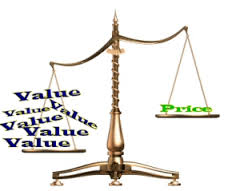
It’s important to remember that you must sell your product or service at a price that is higher than your cost to produce and promote it. That’s called a profit. But perhaps, even more important is knowing that your customer will only buy your product or service if they determine that its perceived value exceeds the price they have to pay to receive it.
Price is a perception of value and has little to do with actual value. The whole goal of your marketing efforts is to spread the word and convince people that the value is higher than the price they are being asked to pay.
I’ll never forget a story I once heard about a fellow who approached the legendary marketer/copywriter Gary Halbert to ask about the seemingly high price he was planning to charge for his new product. He asked Gary, “Do you think people will pay $XX dollars for my new widget?” Gary’s reply is profound and something you should always remember. He said, “I don’t know. How good is the sales letter?”
I love this story because it summarises everything that is great about the power of good marketing. Your product or service’s price has nothing to do with its actual value. It has everything to do with it’s perceived value and how well you can build that perception in the mind of a prospect using effective marketing.
There is also the story of Feargal Quinn, the Irish Supermarket supremo and crusader for excellent customer care. In 1990, he launched his book “Crowning the Customer” and was interviewed on the radio by Gay Byrne. He remarked that the price of his book was £4.95 and he should have made it £4.99. Customers wouldn’t have noticed the difference and he would have made 50,000 extra four pences.
Now go to Part 3