


 Can you learn entrepreneurial skills or are they in your genes?
What does it take to set up a business and to make it successful? And why do fewer Europeans have what it takes? The European Commission asked people throughout the European Union - including, for the first time, citizens of the 10 new Member States - to tell us why they do, or don’t, want to become their own boss.
“Entrepreneurs are the economic DNA which we need to build competitiveness and innovation in Europe.” says Enterprise and Industry Commissioner Gunter Verheugen. “Entrepreneurship can be exciting and rewarding, but it also involves risks and hard work. It is the challenge for Member States and the Commission to ensure that entrepreneurship is encouraged by providing a supportive environment for those choosing to take the risks.”
To encourage more entrepreneurial start-ups, take-overs and growth, the Commission is implementing a number of policy actions under the Entrepreneurship Action Plan. In addition, the Commission reports regularly on progress made by both the Member States and at EU-level towards the goals set by the European Charter for Small Enterprises.
Entrepreneurship is about people, their choices and actions, and the Eurobarometer surveyallows us to identify and analyse what motivates their behaviour. Although 45% of Europeans would like to be their own boss, Americans, at 61%, are more keen to try entrepreneurship. Why are Europeans less keen to “have a go”? What are the obstacles in Europe - real or imagined that help explain why 59% of Europeans have never even considered setting up a business, let alone achieved such a dream?
Balancing the risks
 A regular income is the main motivation for those Europeans who prefer employee status, 30% of respondents citing this reason in our survey as opposed to only 16% of Americans. Job stability is also considered important by 24% in the EU25 compared with only 10% in the USA
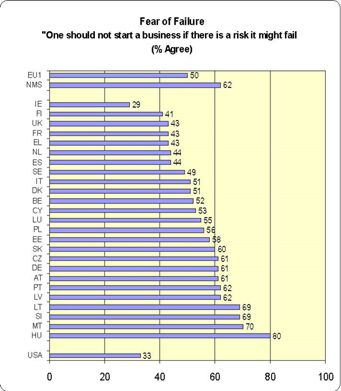
Fear of failure also preoccupies Europeans. Half of the Europeans we asked (see box) agreed that you should not set up a business if it is likely to fail, compared with only one-third of Americans. However the figures vary widely between Member States. Europeans also tend to be more worried by the possibility of bankruptcy (45%) or of losing their property (35%) if their businesses fail, Americans show far less fear for these dangers (36% and 21% respectively).
… and the Rewards
Nevertheless the survey found that one-third of EU citizens would still consider setting up a business in the next 5 years; 40% in the new Member States (NMS). Evidently for some the potential rewards outweigh these risks, and the survey illustrates that the most crucial rewards are not necessarily financial. 77% of Europeans who stated a preference for entrepreneurship cited greater independence and self-fulfilment as an important motivation. This contrasts with only 23% who cited increased earning power.
Of course, entrepreneurship is not always a choice. Whereas 71% of Americans that had started a business did so because they saw an opportunity, and 13% out of necessity, in the EU15 56% were motivated by an opportunity, and in the new Member States this figure falls to 48%. The differences within Europe are not only east-west. Whilst northern Europe has similar levels of “opportunity entrepreneurs” to the US, entrepreneurs in the south often lacked alternatives.
Just do it
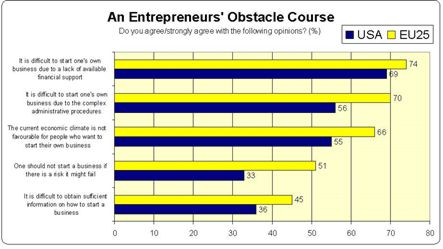 How easy is it for the potential entrepreneur to achieve his or her dream (or necessity)? Only 2% of the Europeans we asked were actually in the process setting up and enterprise, compared to 8% in the US. The Eurobarometer survey shows that the order of importance of perceived obstacles to setting up a business is fairly similar in Europe and the USA; however their magnitude is more marked in Europe. Lack of available financial support still ranks as the single most important factor on both continents (see box), though with considerable variations between European countries.
Administrative burdens come a close second, although comparing the 2004 data to 2003 shows a marked improvement (by 6% in the US, and by 5% in the EU15).
What creates business success?
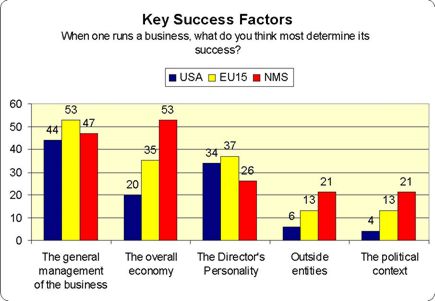 Once established, Americans and Europeans agree that the most important factor for the success of a business is good management. However, Americans see good ideas and good leadership as the next most crucial factors. Europeans, particularly those in the new Member States, believe that external factors, such as the economic and political context, have a far greater influence. Such perceptions will naturally influence the confidence of an individual to launch a business.
Entrepreneurship and Competitiveness – the Policy Challenge
In 2004 the Commission set out its priorities for boosting entrepreneurship in its Entrepreneurship Action Plan. This describes 38 sub-actions in five strategic areas: (1) Fuelling entrepreneurial mindsets; (2) Encouraging more people to become entrepreneurs; (3) Gearing entrepreneurs for growth and competitiveness; (4) Improving the flow of finance; and (5) creating a more SME-friendly regulatory and administrative framework. It also sets out the roles of the different actors involved, ranging from European Commission to national and sub-national authorities and business support organisations.
The great difference between attitudes and experience in different Member States, illustrated by the Eurobarometer figures, demonstrates the continued importance of action at national level. The Commission will continue to help national authorities improve their performance by encouraging the dissemination of good practice through the open method of co-ordination.
In early February DG Enterprise and Industry will publish its annual report on the implementation of the European Charter for Small Enterprises. Although the Charter action lines cover 10 issues linked to enterprise and entrepreneurship, this year the report will identify strengths and weaknesses in national measures in three particular fields:
- Education for entrepreneurship (especially secondary education);
- Better regulation (especially impact assessment and bankruptcy law);
- Skills shortages (especially for skilled technicians and engineers).
Through the Action plan and the Charter, the Commission and Member States are working together to reduce the obstacles and burdens which deter individuals from becoming entrepreneurs. The Eurobarometer provides valuable information on how this support should be targeted. At European level these activities are financed through the Multiannual Programme (MAP) for Enterprise and Entrepreneurship, and particularly for SMEs (2001-5). A majority of MAP financial resources go towards making more private equity and loan capital available to small businesses and leveraging private capital. The MAP also supports the provision of information and advice to enterprises on European issues through the Euro Info Centres and of course makes possible policy development actions under the open method of co-ordination.
Information about the Eurobarometer on Entrepreneurship:
Over 21,000 people were interviewed by telephone in April 2004. These included 18,500 EU citizens, 1,000 Americans and 1500 EEA/EFTA citizens. The results of the survey are broken down by country, but also by socio-demographic characteristics.
The Entrepreneurship Eurobarometer has been in production for 4 years, and its results therefore now permit some analysis of dynamic trends. In the enlargement year the report has been extended to cover 29 countries for the first time.
This article was first published on The Synergy Group site in 2004
Flash Eurobarometer on Entrepreneurship, 2004
Entrepreneurship Action Plan http://europa.eu.int/comm/enterprise/entrepreneurship/action_plan.htm
European Charter for Small Enterprises http://europa.eu.int/comm/enterprise/enterprise_policy/charter/charter2005.htm